
Whether you need a small scissor lift rental for indoor tasks or a 40-foot scissor lift rental for large-scale projects, understanding rental costs and key factors is crucial. When planning your operations, businesses often face the dilemma of renting vs. purchasing a scissor lift. This guide compares scissor lift rental costs with the benefits of buying new equipment, while highlighting how our company delivers high-quality, affordable, and service-driven solutions.
Factors Influencing Scissor Lift Rental Costs
1. Lift Height and Platform Capacity
The most significant determinant of scissor lift rental rates is the machine’s maximum working height. For example:
- 19-foot scissor lift rental: Ideal for indoor repairs or retail spaces, daily rates typically range from $150–250.
- 30-foot scissor lift rental: Suitable for medium-height tasks like warehouse maintenance, averaging $250–250–400 per day.
- 40-foot scissor lift rental: Used in construction or exterior painting, costing $400–600 daily.
Platform capacity also affects pricing. A standard lift supports 320–680 kg (as seen in models with “320KG capacity” in specifications), but heavy-duty variants with higher capacities may cost 10–20% more.
2. Terrain Compatibility
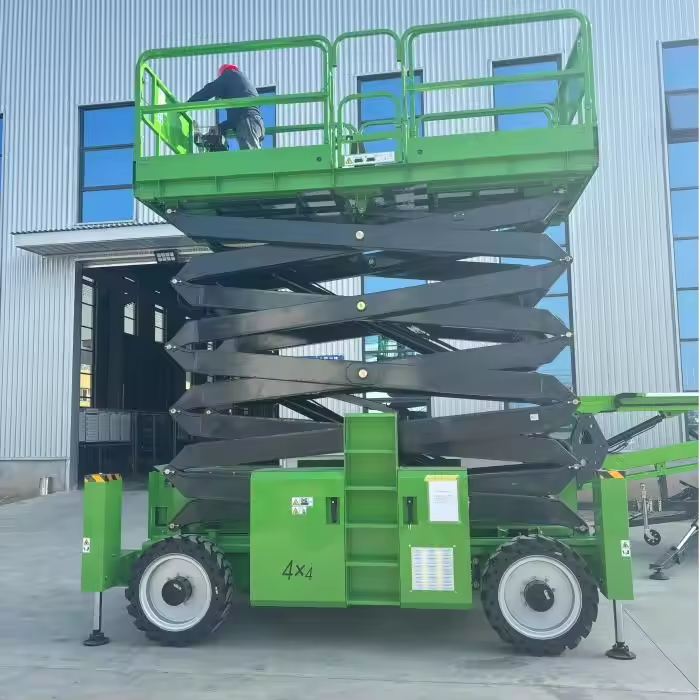
- All-terrain scissor lift rental: Equipped with rugged tires and enhanced stability for outdoor use on uneven surfaces. Rates start at $300–500 daily.
- Rough terrain scissor lift rental: Designed for construction sites with muddy or rocky ground, priced 20–30% higher than standard models due to advanced hydraulics and durability.
3. Rental Duration
Most providers offer discounts for longer rental periods:
- Daily rates: Ideal for short-term projects.
- Weekly rates: Often 3–4 times the daily rate (e.g., a 200/daylift∗∗maycost∗∗600–$800 weekly).
- Monthly rates: Up to 50% cheaper than daily pricing.
4. Additional Features
- Electric vs. diesel: Electric lifts (like the “24V/4.5Kw” model) are quieter and eco-friendly, ideal for indoor use but may cost slightly more than diesel-powered options.
- Dual controls: Models with dual controllers (as listed in product specs) enhance safety and efficiency, potentially adding 5–10% to the base rate.
Average Scissor Lift Rental Prices by Type
| Lift Type | Daily Rate | Weekly Rate | Key Applications |
|---|---|---|---|
| Mini scissor lift rental | $100–200 | $300–600 | Indoor maintenance, retail |
| 19 ft scissor lift rental | $150–250 | $450–800 | Ceiling repairs, signage |
| 30 ft scissor lift rental | $250–400 | $750–1,200 | Warehouse stocking, painting |
| 40 ft scissor lift rental | $400–600 | $1,200–1,800 | Construction, exterior work |
| All-terrain lift rental | $300–500 | $900–1,500 | Landscaping, outdoor events |
Note: Prices vary by location, season, and supplier.
Cost-Saving Tips for Renting a Scissor Lift
- Compare Multiple Suppliers
Request quotes from local and national rental companies. For example, bulk suppliers like the one offering “≥5 pieces at $3,600 each” may extend discounts for large orders. - Opt for Off-Peak Rentals
Demand spikes during spring and summer; consider renting in winter for lower rates. - Verify Included Services
Ensure quotes cover delivery, insurance, and maintenance. Some providers, like the Alibaba supplier offering “free part delivery”, include complimentary accessories. - Train Operators In-House
Certified operators reduce liability risks and avoid mandatory (and costly) training fees from rental firms.
Specialized Scissor Lift Rentals
1. Small Scissor Lift Rental
Compact models (e.g., “mini scissor lifts”) with 10–15 ft reach are perfect for tight spaces like offices or retail stores. Rates start at $100/day, making them budget-friendly for short tasks.
2. Heavy-Duty Rough Terrain Lifts
These lifts feature reinforced frames and all-wheel drive, ideal for construction sites. Expect to pay $500–800 daily for a 40-ft model.
3. Hybrid Electric-Diesel Options
For mixed indoor/outdoor use, hybrid lifts balance power and emissions compliance. Prices align with diesel models but offer greater versatility.
Hidden Costs to Consider
- Transportation Fees: Delivery/pickup can add $50–200, depending on distance.
- Insurance: Liability coverage may cost $25–50 daily.
- Overtime Charges: Exceeding agreed rental periods often incurs 1.5x the hourly rate.
Renting vs. Buying – Key Pros and Cons
Advantages of Renting
- Flexibility and Low Upfront Costs
- Ideal for short-term projects or seasonal needs; avoids depreciation risks.
- Access to newer models without long-term commitments.
- Maintenance and Support
- Rental companies handle repairs and servicing, reducing operational burdens.
- Tax Benefits
- Rental fees may qualify as tax-deductible operating expenses (varies by region).
Disadvantages of Renting
- Higher Long-Term Costs
- Extended rentals (e.g., over five months) may exceed the cost of purchasing.
- Availability Risks
- High-demand models may be unavailable during peak seasons.
- Limited Customization
- Rentals cannot be modified for specialized tasks.
Advantages of Buying
- Cost-Effective for Long-Term Use
- More economical if annual utilization exceeds 60%.
- Full Control and Customization
- Customize features (e.g., explosion-proofing, extended platforms) for specific needs.
- Asset Value
- Equipment can be resold or used as collateral; residual values typically range from 30–50%.
Disadvantages of Buying
- High Initial Investment
- New scissor lift prices:
- Small (19 ft): 8,000-15,000
- New scissor lift prices:
- Maintenance Responsibilities
- Annual maintenance costs average 5–10% of the purchase price.
- Technology Obsolescence
- Older models may lose resale value as newer technologies emerge.

Why Buy from Us?
For businesses with frequent needs or long-term goals, purchasing a new scissor lift delivers superior value. As a professional scissor lift manufacturer, our lifts have obtained CE, SGS, ISO, BV, CCS and other certificates. stands out with premium quality, competitive pricing, and unmatched service:
Uncompromising Quality
- High-Grade Materials: Platforms use high-strength steel, supporting 500 kg loads (20% above industry standards).
- Advanced Powertrains: Rexroth hydraulic systems enable 35% gradeability for rough terrain.
- Certified Safety: Compliant with ISO 9001, ANSI/SAIA A92.20, and other global standards.
Pre-Sales Service:
- Technical support and tailored advice for machine selection based on your workplace.
- Full testing of all machines before shipment.
- Factory visits are welcome.
After-Sales Service:
- Operation manuals and machine usage training provided.
- Engineers available for overseas service.
- 12-month warranty with consumable parts at cost after.
- 24/7 technical support via email, phone, or video.
Decision Flowchart – Rent or Buy?
High Usage (>60 days/year) → Purchase (Save $20,000+ over 5 years )
│
├─ Short-Term Projects (<3 months) → Rent (e.g., **30 ft lift at $250–$400/day**)
│
└─ Long-Term + Custom Needs → Purchase (Customizable platforms/power options)
Customer Success Stories
Case 1: U.S. Retail Chain Upgrade
- Need: 30 stores requiring 200 days/year of aerial work
- Previous Solution: Rented 10×19 ft lifts ($450k/year)
- XX Company Solution: Purchased 15×19 units,saving 700k over 3 years
Case 2: Construction Contractor Efficiency Boost
- Challenge: Frequent unavailability of 40 ft all-terrain rentals ($600/day) during peak seasons
- Solution: Purchased 5 units with financing, increasing equipment utilization by 40%
Conclusion and Recommendations
Renting a scissor lift involves balancing height requirements, terrain conditions, and budget. A 19 ft scissor lift rental might suffice for minor repairs, while a 40 ft scissor lift rental is essential for industrial projects. Always confirm machine specifications—such as “high-strength steel” construction or “anti-slip platforms”—to ensure safety and efficiency. By comparing scissor lift rental prices and negotiating terms, you can optimize costs without compromising on quality.
- Short-Term/Temporary Needs: Renting provides flexibility and cost efficiency.
- Long-Term/High-Frequency Use: Purchasing maximizes ROI and operational autonomy.
Renting suits short-term or unpredictable needs, but purchasing a scissor lift is a strategic investment for long-term savings.Our company combines factory-direct pricing, lifetime support, and modular designs (easy repairs/upgrades) to maximize your ROI.
About Us
Please note: We specialize in selling new scissor lifts and do not offer rental services. Our inventory includes all-terrain, rough-terrain, self propelled scissor lift and compact models (19 ft to 60 ft), with customizable solutions and after-sales support. Contact our sales team for quotes or technical inquiries.